




Abstract
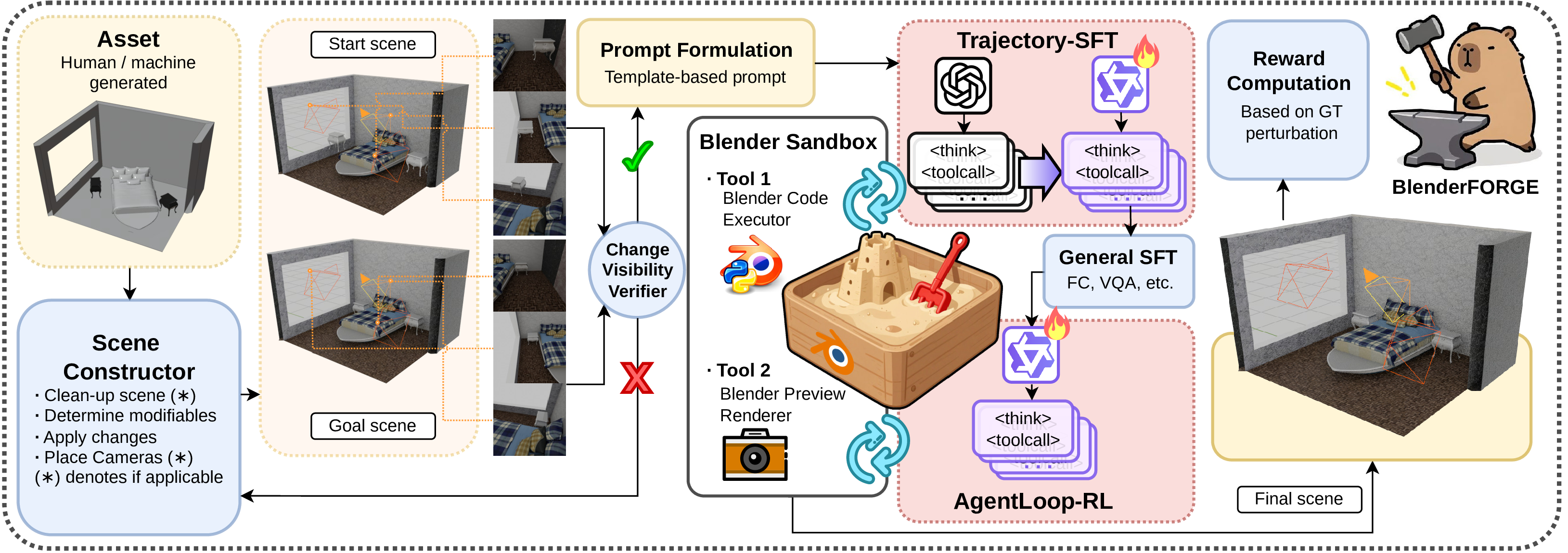
Precise, programmatic 3D editing requires executable interaction and verifiable feedback. We introduce BlenderFORGE, a data–environment–optimization framework for training open-weight multimodal agents to edit Blender scenes through Python code. The framework combines perturbation-based task generation, an instance-isolated Blender sandbox, and a two-stage training pipeline comprising trajectory supervised fine-tuning and multi-turn AgentLoop-RL. It covers four task families: object placement, shape-key editing, lighting adjustment, and material modification. The trained Qwen3-VL-8B agent improves over its base model across all four families. Evaluations on held-out camera tasks, BlenderGym, and a second model backbone provide additional evidence of transfer.
Demonstrations
Object Placement
Shape-Key Editing
Lighting Adjustment
Material Modification
Quantitative Results
Comparison of zero-shot and BlenderFORGE-trained models on the test set. Results include Qwen3-VL-8B and Qwen3.5-9B backbones.
Citation
@inproceedings{guo2026blenderforge,
  title     = {{BlenderFORGE}: Framework for Optimizing Reactive
               {3D}-Graphics Editing Ability of {MLLMs}},
  author    = {Guo, Zilin and Zhang, Tianrui and Rong, Yi and
               Liu, Yichen and Guo, Yuxin and Ni, Jingcheng and
               Lu, Lewei and Wu, Zehuan and Xu, Dan},
  booktitle = {The Fortieth Annual Conference on Neural Information Processing Systems},
  year      = {2026},
  url       = {https://openreview.net/forum?id=czK5BBdtMP}
}